
How Much Feed Do Meat Birds Need When They Switch from Starter?
We’re bringing back this blog post, because we receive lots of questions about how much meat birds will eat. This post helps you get to an answer, which depends on the breed and your goals.
The Short Answer:
This is a tricky question because there are a number of factors involved, including age, breed, indoor/outdoor and temperature/location.
Conventional wisdom (for example, the Purina website) poses that each bird will eat 10 pounds of food in its first six weeks, and then 3-4 pounds per week. However, these numbers don’t hold for chickens fed on Union Point feed, which is nutrition-dense and low-waste. Our very general guideline is that after they move from starter around days 25-35, you’ll want to feed about 1/4 lb per chicken/per day. Remember that up to a point, chickens demand more feed as they grow.
Our Grower with Pumpkin is corn-free, soy-free and GMO-free and is packed with the most nutritious, digestible and waste-free form. It is made from wheat, peas, fishmeal, pumpkin seeds, brewers’ yeast, kelp, and all the vitamins and minerals your birds need to grow efficiently and safely. This has been the choice of many homestead meat bird growers for many years because it works so well. It contains 18% crude protein from perfectly balanced amino acid proteins like lysine and methionine abundantly found in the Northwest-grown ingredients we love.
With our feed, you can expect rapid healthy growth and vigorous birds that reach their full genetic potential, producing top-quality meat with the home-raised taste that is our goal.
Because of great variance in contributing factors, you should always use your own judgment and observation of your flock over general guidelines!
The Longer Answer:
Ours is very efficient feed with no loss to dust and it is nutrient dense so you can use a "feed conversion rate" of about 2.5 to 1 if the weather is decent, more like 3:1 if it is not. So if you grow a bird to a butcher weight of 7 lbs. (That's live weight.) It will eat about 7 x 2.5 lbs. of feed, or about 15-18 lbs. of feed in its lifetime. The worst case would be 21 lbs., the best case, 15 lbs.
If they will be housed in inside conditions, the conversion is more like 2:1, or 14 lbs. (You don't count on the grass for much of their growth. It's more like salad. It makes them healthier, it makes them happier and they like to eat it, but it doesn't put much weight on them.) If you like a smaller bird, of course it will eat less and be ready younger.
So, if you had 100 birds, for the season you would use 100 x 18 lbs. = 1800 lbs. of feed (1500-2100). Fifty birds = 900 lbs., etc. But how big you want them, the weather, etc. all figures in.
Now, Ranger-type birds are different. We are often asked how much alternative breeds eat in a pasture model. Figures based on the various alternative breeds are not as well studied and less reliable because of the many differences in management inherent in pasture-based systems in different areas, different climates and so on. You might check out this article from a SARE grant cited here.
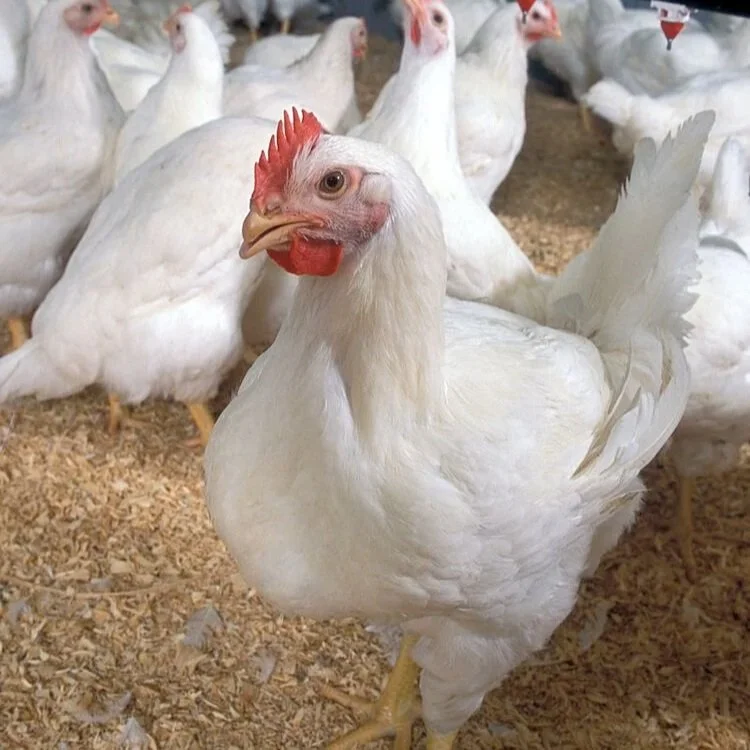
Between weather, management practices and quality of feed, your mileage is likely to vary quite a lot. This is where on-the-ground animal husbandry and care come into play. Of course, we’re proud of the efficiency and extremely low waste growers experience with our feeds.
The takeaway from their study was that the Rangers were going to have to live longer, and although they ate about the same amount of feed per day as the Cornish, they ate for more days and so came out eating about 30% more by the time they were harvested. They found that if a Cornish bird used between 15 and 18 lbs. of feed (see above), a Ranger might eat from 19.5 lbs. to 27 lbs. I did the math myself from their figures, so they are not written in stone, and they are based on extrapolation from their data. I think those numbers might be a little high. Chances are, the Rangers will be harvested smaller than the Cornish, so the lower number is probably more accurate. But between weather, management practices and quality of feed, your mileage is likely to vary quite a lot. This is where on-the-ground animal husbandry and care come into play.